May is Asian American and Pacific Islander Heritage Month, which celebrates the rich cultures, traditions, histories, and contributions of Asian Americans and Pacific Islanders throughout the history of the United States. As a dining services provider, our celebration revolves around food, so it’s only natural to highlight this month through that lens. Let’s take a look at some of today’s notable Asian American and Pacific Islander chefs and their culinary contributions and achievements.
Filipino American chef Cristeta Comerford was in charge of the food in the most influential American home: the White House. When named executive chef in 2005, she became the first woman and first person of Asian origin to hold the position. She served in the role for nearly 20 years until she retired in 2024.
It’s hard to classify the multitalented Eddie Huang, who’s achieved success in the culinary world as a chef and restaurateur, and in the entertainment world with a sitcom based on his bestselling memoir, “Fresh Off the Boat.” But those are only a few of Huang’s accomplishments (lawyer and clothing designer are also on his resume). Huang, however, would say that he’s the anti-chef. In an interview with NPR, Huang stated, “I never wanted to be a chef. I cooked food because it was the place that Asian people could have narratives in this country. I’m meant to write, and I want to tell stories.”
Chef, restaurateur, “Top Chef” contestant, television personality, and cookbook author Sheldon Simeon doesn’t stray far from his roots. The Hilo native’s culinary perspective is decidedly Hawaiian, but when you visit his restaurants Tin Roof and Lineage, you’ll find fusion cuisine at its finest, with nods to Korean, Portuguese, Filipino, and Japanese flavors. Simeon’s fresh take on Hawaiian food earned him “Food & Wine” magazine’s People’s Best New Chef for the Pacific and Northwest in 2014.
If you’re a fan of hybrid or fusion tacos, you should know that Roy Choi is the chef to thank. Choi skyrocketed to fame with delicious Korean-Mexican tacos, sold from his Kogi BBQ taco truck. Known as one of the founders of the gourmet food truck movement, chef Choi is also a successful restaurateur, author, and television personality. To be sure, Choi’s taco fame is anything but a fluke, especially with a degree from The Culinary Institute of America and time cooking at Le Bernardin. What started as a desire to introduce Korean food to people across Los Angeles became a brilliant fusion that incorporated an already popular local food: the taco.
Check out these recipes inspired by the culinary perspectives of Cristeta Comerford, Eddie Huang, Sheldon Simeon, and Roy Choi.
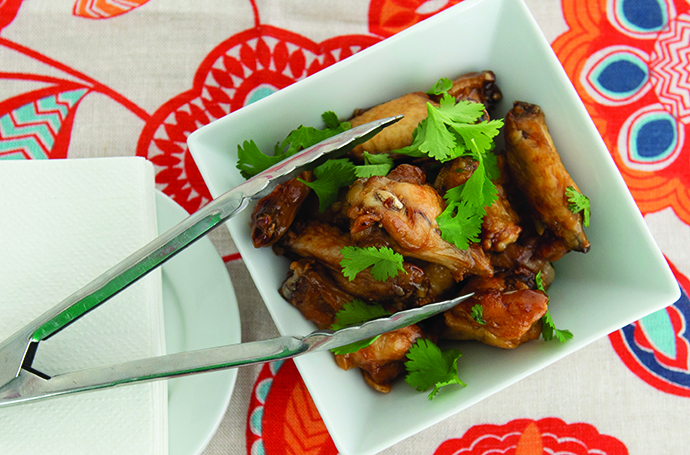
Filipino Marinated Chicken Adobo
Servings: 6
2 ½ pounds boneless, skinless chicken thighs
2 teaspoons ground black pepper
½ cup soy sauce
1 bay leaf
¼ cup Chinese black vinegar
1 ½ tablespoons vegetable oil
2 ½ tablespoons chopped garlic
½ bunch chopped green onions
- Cut chicken into 1 ½-inch pieces.
- In a container, combine all ingredients except oil and green onions. Cover and refrigerate for 12 hours or overnight.
- Strain the chicken marinade and reserve. Sear the chicken in oil until browned.
- Add the reserved marinade and bring it to a simmer. Cook until tender. Remove the chicken from the pan and keep warm.
- Continue to cook pan juices until slightly thickened. Remove the bay leaf and pour over the chicken. Garnish with green onions.
Shanghai-Style Braised Pork Belly
Servings: 6
2 pounds pork belly
2 tablespoons soy sauce
1 4-inch piece of ginger root, sliced
2 cups water
2 tablespoons vegetable oil
1 teaspoon salt
1 tablespoon granulated sugar
1 whole star anise seed
1 bunch green onions
1 cinnamon stick
1 dried hot chile pepper (optional)
½ cup cornstarch
1 teaspoon Sichuan peppercorns
½ cup water
2 tablespoons Shaoxing wine
- To prepare ingredients: Cut the white part of the green onions into 3-inch pieces (you don’t need green parts).
- Bring a pot of water to boil. Add the pork belly and ginger, making sure they’re fully immersed. Cook for 5 minutes, skimming and removing any meat proteins that rise to the surface. Drain; rinse the pork and ginger with cold water. Cut the pork belly into 1-inch cubes and set aside.
- Heat the oil and sugar in a pot over a low flame. Once the sugar starts to melt, add the pork, ginger, green onions (white parts), the chile pepper, and peppercorns. Increase the heat to high and cook until browned.
- Add the wine and soy sauce to mixture, stirring constantly. Add 2 cups water, salt, star anise, and cinnamon stick to the blanched pork belly. Bring to a gentle boil. Once the mixture begins to boil, reduce the heat and cover. Simmer for at least 2 hours, stirring occasionally.
- Remove the pork belly and keep hot. Strain the liquid into a saucepan and place over medium heat. Combine the cornstarch and ½ cup water; add to liquid and cook until thickened.
- Pour the sauce onto the pork belly and serve.
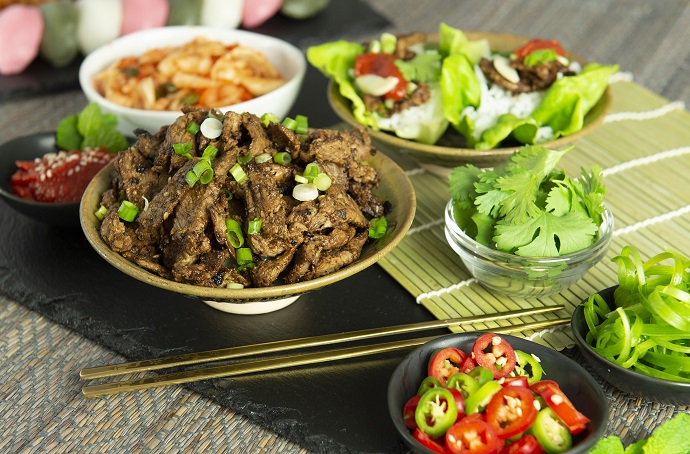
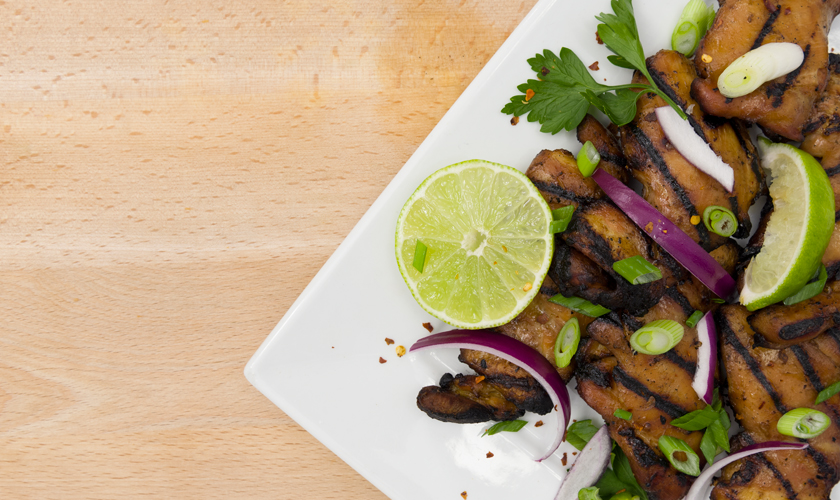
Huli Huli Chicken
Servings: 6
½ cup ginger root, peeled and minced
1 ½ tablespoons gochujang (Korean chile paste)
2 teaspoons fresh, peeled garlic cloves, minced
1 ¾ teaspoons Worcestershire sauce
⅓ cup brown sugar
1 ¼ teaspoons sherry vinegar
⅓ cup ketchup
1 ¾ teaspoons sesame oil
⅓ cup soy sauce
3 pounds boneless, skinless chicken thighs
- Combine all the ingredients except the chicken; mix well. Add half of the sauce to the chicken and toss to coat. Refrigerate overnight. Reserve the other half of the sauce in the refrigerator.
- Preheat grill.
- Remove the chicken from the marinade and discard the marinade.
- Cook the chicken on the grill, basting frequently with reserved sauce until proper internal temperature (165°F/74°C) is reached.
Kimchi Fried Rice
Servings: 6
1 cup sushi rice
2 tablespoons fresh, peeled garlic cloves, minced
1 cup water
¼ cup ginger root, peeled and minced
1 ¼ cups premade kimchi
1 bunch green onions
2 eggs
½ cup yellow onion, diced
2 tablespoons soy sauce
¼ cup water
3 tablespoons salted butter
1 tablespoon sesame oil
6 tablespoons vegetable oil
2 teaspoons kosher salt
1 jalapeño pepper, thinly sliced
1 teaspoon ground white pepper
*Fried rice is best made with cooled rice, so it doesn’t stick together.
Sticky Rice
- Rinse the rice in a bowl until the water runs clear. Strain and let drain for 30 minutes.
- Place the rice and 1 cup of water in a pot. Cover and bring it to a simmer.
- Reduce the heat to low and let cook for 5 minutes. Turn off the heat and let rest for 15 minutes. Uncover and fluff with a fork. Refrigerate overnight.
Fried Rice
- To prepare ingredients: Drain and rough chop the kimchi. Whisk the eggs. Trim and thinly slice the green onions.
- In a wok or pan, heat 4 tablespoons of vegetable oil. Add the rice and yellow onion; stir-fry until lightly charred and heated. Remove from heat and place in a bowl; keep warm.
- In a skillet, heat the remaining vegetable oil and sesame oil. Stir-fry the ginger, garlic, and half of the green onions until fragrant.
- Add the kimchi, butter, salt, and white pepper. Continue to cook until the kimchi takes on some color.
- Add the cooked rice, soy sauce, and water. Mix well and continue to cook until heated through.
- Make a well in the middle of the vegetable mixture once hot and add eggs into the well. Fold the rice into the center, cooking the eggs through.
- Place in a serving dish; top with shaved jalapeño and remaining green onions.
Try these additional recipes: